Writer’s Double
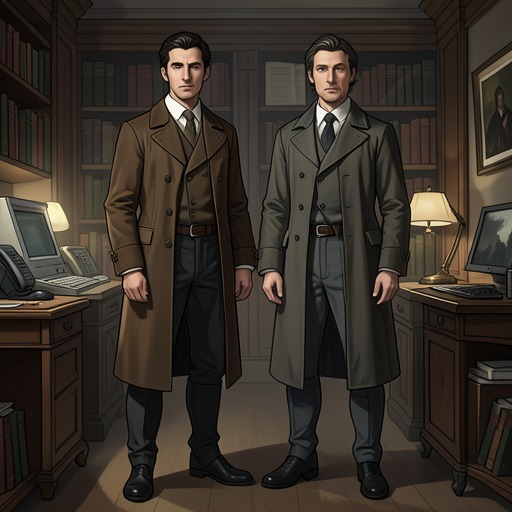
The Dark HalfWriter’s Double is the novel’s defining tension between Thad Beaumont and George Stark: first a chosen separation between an author and his pen name, then a supernatural and psychological division that calls the separation’s reality into question. Thad imagines Stark as an identity apart from himself; as Stark becomes flesh, the story complicates any clean division between creator and creation, showing that the double is both made by Thad and bound to him in ways he does not understand.
A pen name built for a different kind of writing
Thad’s choice of a separate identity begins with a practical need. He hopes a new name will break the writer’s block he is struggling with, and insists that the identity must be distinct from his own. His model is Donald E. Westlake’s use of the pen name Richard Stark: Westlake’s work under his own name differs sharply from the crime novels published as Stark, which follow Parker, a professional thief with few interests beyond robbery. Thad recalls Westlake’s description of writing on sunny days while Stark took over on rainy ones, and connects that division to his own difficult period between 1973 and early 1975.
The resemblance is not merely nominal. Thad describes Parker as nearly a programmed machine, fixed on a single aim and repeating his demand for money. That hard, narrow criminal logic anticipates Alexis Machine, the principal character of the first and last George Stark novels. The fictional identity gives Thad access to a style that feels separate from his own, but its apparent independence is already a craft arrangement: Thad makes the division in order to write.
The first Stark novel does not remain a simple imitation. Thad says that if Machine’s Way had continued as it began, he would have put it away rather than publish it; about a quarter of the way through, however, the book found its own rhythm. The change marks a crucial ambiguity in the double’s origin: Thad deliberately creates a separate authorial voice, yet describes the writing as developing a momentum he did not initially plan.
The persona’s appeal and the cost of separation
The separation carries an emotional charge as well as a literary one. Thad recognizes that some part of him is drawn to Stark’s uncomplicated violence and apparent immunity to weakness. Stark seems free of the fears, domestic commitments, and ordinary burdens that constrain Thad: a wife and children, teaching duties, and the demands of work and civic responsibility. The attraction is not the same as approval. Thad calls Stark a bastard, but also recognizes that this condemnation does not erase the appeal.
That recognition makes Thad question whether he merely created Stark or whether a longing part of him helped bring Stark back. During a moment of uncertainty about whether he can use the sparrows, he fears that the part of himself that loves Stark may be preventing him from acting against him. The double thus exposes a conflict within Thad, not just an external threat: opposing Stark means confronting both the danger Stark presents and the desire for the freedom his persona represents.
The novel also makes the division visible in ordinary writing tools. Thad becomes acutely aware of pens, pencils, and his IBM Selectric, wondering whether each might contain a different version of himself, like a presence waiting inside a bottle. A note he thinks he must write to the late Mrs. Fenton appears in his mind without an obvious cause; he recognizes that the thought is out of place, since she had been far from his thoughts. Writing, once the means by which Thad constructed a separate identity, becomes an unsettling point of contact with forces and thoughts he cannot confidently assign to himself.
The twin beneath the authorial double
The account of Thad’s childhood gives the division a bodily and historical dimension. Dr. Pritchard explains that the absorption of Thad’s twin in the womb was incomplete: a small amount of the other twin’s tissue remained entwined with the tissue that became Thad’s brain. It became active not long after Thad turned eleven and began to grow, so Pritchard removed it surgically. Alan Pangborn understands the revelation as evidence that Thad has always been two men, connecting the split to the division between the person who exists in the ordinary world and the person who creates worlds.
This explanation does not reduce Stark to a straightforward product of Thad’s conscious intention. Alan’s interpretation is that the two of them participated in the creation together. Thad tried to end the other twin’s presence before birth without fully succeeding; Pritchard’s operation suppressed the remaining tissue, but only for a time. Finally, Thad invited Stark back without knowing what he was doing, in part because Pritchard had never told him about the retained twin tissue. Alan calls Stark the ghost of Thad’s dead brother, while emphasizing that the relationship is at once more and less than that description suggests.
The disclosure reframes the double as an unstable relation among bodily origin, memory, and authorship. The childhood surgery supplies a history for the division, but does not make its later return a simple medical consequence. The narrative instead joins the twin’s survival, Thad’s unknowing invitation, and the act of writing into a chain of creation whose participants cannot be cleanly separated.
Shared authorship and the limits of control
Stark claims that he taught Thad to write work people would want to read, and that Thad owes him. He describes his own failing creative capacity as a gland that has stopped working and says he wants a transfusion from Thad, whose abilities he believes can restore it. Stark’s account treats Thad as the source of the means he needs, while also insisting that the two are bound through a shared creative history.
Alan rejects Stark’s claim to sole authorship. In his view, Stark and Thad did it together: Stark was present all along, and the relationship predates both the suppressed tissue and Thad’s conscious understanding of his creation. Stark offers a different account of his arrival, saying that at a certain point he created himself and that the effort has left him with difficulty writing. The contrast between his explanation and Alan’s makes authorship itself part of the conflict: Stark claims self-creation and a debt owed to him; Alan sees a joint origin that Stark cannot fully recognize.
The double therefore disturbs the usual distinction between a writer and a character. Thad’s pen name begins as a chosen device, but Stark’s demand for renewed creative power makes the arrangement a struggle over who produced whom and who may claim the work. In the novel’s terms, separation is never complete: the independent persona depends on Thad even as it insists on its own authority, while Thad must confront the possibility that his own desires helped give that persona life.